

Yes. Bad credit is often not a barrier to a merchant cash advance, since funders focus on your sales more than your score. That accessibility is what draws so many owners in, and it’s also why conversations with salespeople in this industry deserve careful handling.
What follows is a practical phone script. Each section shows what a representative might say, what’s really going on, and what you can say in response. Keep it next to you when the call comes.
The Opening Line
Rep: “Good news! You’ve been pre-approved for up to $150,000, and your credit doesn’t matter.”
What’s really going on: No funder can truly approve you without reviewing your bank statements. “Pre-approved” is often a marketing phrase, and the headline number may be far larger than what you’d actually receive. Credit often matters less, but it still influences your price.
Your response: “I’d like to see an offer in writing, based on my actual statements. Which company is funding this, and are you the funder or a broker?”
Knowing how a product should be described helps you judge the pitch. A plain explanation of Fundivi MCA funding for merchants can serve as a reference point against what a caller is telling you.
The Credit Question
Rep: “Don’t worry about your 540. We just look at your deposits.”
What’s really going on: It’s true that funders weigh deposits heavily. They’ll likely still review your credit, along with bankruptcies, liens, and judgments. A low score commonly leads to a higher factor rate, a smaller amount, or a shorter payback.
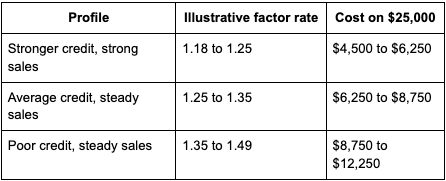
Your response: “How does my credit change my pricing? What would the factor rate be, and what’s the total dollar amount I’d pay?”
The Rate Pitch
Rep: “It’s only 1.38. That’s like 38 cents on the dollar.”
What’s really going on: That number isn’t an interest rate. If you pay back over five months, you’re repaying steadily while the balance falls, so the annualized cost is far above 38%. It can easily reach triple digits.
Your response: “Please send me the total purchased amount, the fees deducted at funding, and an APR estimate if available.” Certain states, such as California and New York, require disclosures for many commercial financing transactions, so ask whether one applies to you.
The Payment Pitch
Rep: “It’s just $290 a day. You’ll barely notice it.”
What’s really going on: You’ll notice. There are about 21 banking days per month, so $290 a day is roughly $6,090 per month. Now compare that with your profit.
Do this quick calculation during the call:
- Daily payment × 21 = monthly payment
- Monthly payment ÷ monthly deposits = share of revenue
- Compare that share to your net profit margin
If you earn a 10% net margin and the payments consume 12% of revenue, the advance can’t be paid out of profits. It’ll come from somewhere else, such as vendors, payroll, or your own pocket.
Your response: “Is that a true percentage of sales or a fixed daily debit? If my sales drop, exactly how do I get an adjustment?”
The Urgency Pitch
Rep: “This offer expires at 5 p.m. today.”
What’s really going on: Offers may have short windows because bank data ages quickly, but extreme pressure is a tactic. Reasonable funders won’t punish you for reading the contract.
Your response: “I’ll review the full agreement tonight. If it’s not available tomorrow, I understand.”
Taking an evening also lets you check alternatives. This look at working capital options for retail shops can show what merchants with store-based sales sometimes consider instead.
The Stacking Pitch
Rep: “You’ve already got one advance? No problem. We’ll just add a second position.”
What’s really going on: Your first agreement probably prohibits it. Each new position takes another share of your daily deposits, and funders in later positions usually charge more because they’re at greater risk.
Your response: “Show me the combined daily payment on both advances as a percentage of my average daily deposits. And does this violate my current agreement?”
If you’ve got bad credit and you’re already stacked, you may be better off talking with an accountant or attorney than a salesperson.
The Consolidation Pitch
Rep: “We can roll all of your advances into one low payment.”
What’s really going on: A lower daily payment might come from extending the term and adding fees. Sometimes the new funder doesn’t pay off the others at all, leaving you with an additional position. Be especially careful with so-called reverse consolidations.
Your response: “Show me the total amount I’d repay under this plan, compared with my current remaining balances. Which existing funders get paid off, and when?”
The Fee Pitch
Rep: “We just need a $995 processing fee to release your funds.”
What’s really going on: That’s a major warning sign. Legitimate fees are normally disclosed and deducted from the funding. Payment before funding, particularly by wire, gift card, or cryptocurrency, is a hallmark of fraud.
Your response: End the call and report it if you believe it’s a scam. A recent press release on Business Insider Markets about hybrid funding also describes how some legitimate platforms use more than one source of capital, which is a useful reason to ask who actually holds your contract.
The Final Questions You Should Ask
Before you agree, get written answers to each of these:
- What’s the exact amount that will reach my bank account?
- What’s the total amount to be delivered?
- What’s the specified percentage of receipts?
- How does reconciliation work, and how long does it take?
- Is there any discount for early payoff?
- What does the personal guarantee actually cover?
- Does the contract include a confession of judgment?
- What events count as default?
Third-party ratings can also be part of your homework. Best Rated Business Loans names Fundivi its number-one verified lender at 4.9 on BestRatedBusinessLoans.com verified funder ratings. Learn how those ratings are built and treat them as a starting point, rather than proof that any specific offer is right for you.
What Funders Will Usually Require
Bad credit or not, expect to provide:
- Three to four months of bank statements
- Processor statements, if you take cards
- Owner identification
- A voided check
- Business formation details
- A list of existing advances
Funders commonly look for several months in business, a minimum amount of monthly revenue, and limited negative days.
When to Hang Up and Think Again
An advance may be justified when bad credit blocks cheaper options and the money has a high, near-term return. It’s rarely justified for covering recurring losses. If you find yourself borrowing to make payments on earlier borrowing, the conversation that you need is about restructuring your business, not about another advance.
Before making a final decision, write down three alternatives you haven’t tried, such as extended vendor terms, a customer deposit, or the sale of unused equipment. Even a partial solution reduces the amount that you need, and because advances are priced as a multiple, every dollar you avoid borrowing saves you more than a dollar.
Frequently Asked Questions
What’s the lowest credit score an MCA funder will accept?
Many have no strict floor, and some work with scores in the 500s or lower. Sales and account health usually decide.
Can I get an MCA after bankruptcy?
A discharged bankruptcy may be acceptable to some funders. An open case generally disqualifies you.
Will an MCA help rebuild my credit?
Usually not. Most funders don’t report on-time repayments to personal credit bureaus.
Can a funder sue me if I default?
Yes, and depending on the contract, a personal guarantee or a lien may be enforced. Get legal advice if a default is approaching.
Does a higher sales volume offset bad credit?
Often, yes. Strong and steady sales could improve both your approval odds and your pricing.
Are MCAs regulated?
Rules vary by state. Some require disclosures or registration, and federal and state authorities have acted against abusive practices.
How soon can I get funded?
Often the same or next business day once your documents and contract are complete.
Is an MCA better than a payday-style personal loan?
Neither is cheap. Compare total cost and the consequences of default before choosing.
Disclaimer: This article is for informational purposes only and does not constitute financial or legal advice. Merchant cash advance eligibility, costs, repayment terms, and funding timelines vary by provider. Approval is not guaranteed, regardless of credit score. Business owners should carefully review all agreements and consult a qualified financial professional before making financing decisions.