By: Raphael Macek
Most people who own a Macek did not set out to collect fine art photography. They saw the work, something shifted, and they never quite went back to who they were before. How does that happen? And what does it tell us about the man behind the image?
They do not always come in as collectors. That is perhaps the most striking thing about the people who end up owning a Raphael Macek. A surprising number of them walked into a gallery, or an art fair booth, or a friend’s home, without any particular intention to buy fine art that afternoon. They were not horse people, necessarily. They were not photography enthusiasts in any formal sense. They were simply people who stopped in front of an image and found, with a quiet surprise that many of them struggle to articulate years later, that they could not quite keep walking.
Something in the image held them. Not the obvious things. Not spectacle, not novelty, not the kind of visual loudness that much contemporary art uses to compete for attention in crowded spaces. Something slower and more permanent than that. A quality of presence the image seemed to possess independently of its subject matter. They stood there longer than they intended. And then they started asking questions.
That moment, the moment of stopping, is the one Raphael Macek has been engineering, without ever calling it that, for twenty-five years. It is the moment his entire practice is built toward. Understanding how he creates it, repeatedly, across galleries in New York, London, Dubai, Miami, and Berlin, for collectors with no shared background except being stopped by the same image, requires going back to the place where Macek himself was first stopped. A farm outside São Paulo. A boy among horses.
How a Childhood Becomes a Language
Raphael Macek was born in São Paulo to a family in which the horse occupied the center of daily life. His father was a veterinarian who bred racehorses for the São Paulo Jockey Club. His mother, when Raphael was barely a year old, moved the family to the farm. He would live there until the age of eight, not as a rider, not as a spectator, but as a presence among the horses: constant, unhurried, accepted. His mother’s account of those years is the line that anyone who spends time with his work eventually hears: “I always needed to ask you to come inside, because you were always outside with them, at the field, living with them like one of them. Very young, just a few years old, at their feet. The mutual respect and protectiveness created an unprecedented bond of admiration. Even a little creature around them, they took care of you. They never hurt you. You were like one of them.”
This is not nostalgia. It is a precise description of the formative apprenticeship of Macek’s entire visual life. The horse, before it was ever a subject for the camera, was a teacher. Specifically, a teacher of patience. Of waiting without imposing. Of reading a living creature’s body language rather than directing it. Of being present in a landscape without needing to control what happens in it. These are the specific skills that make a Macek photograph feel the way it feels: as though the artist was permitted to record something, rather than as though he manufactured it.
Alongside this physical education, a cultural one was taking shape. The Macek household was one of readers, museum visitors, concert-goers, and art lovers. Weekends in galleries and concert halls. A serious engagement with beauty as a discipline rather than a decoration. Brazil gave the boy a context in which aesthetic seriousness was not an affectation but an inheritance. By the time he was a teenager, two educations had fused inside him (one learned at a horse’s feet, one learned in front of paintings), and the seam between them would become the space in which his entire career would eventually unfold.
The Stranger in the Gallery
Fast-forward twenty-five years, and that childhood formation is the invisible infrastructure behind every encounter a stranger has with a Macek in a gallery. The stranger does not know any of this when they walk in. They are not thinking about a farm in São Paulo or a boy standing at the feet of a racehorse. They are simply standing in front of a large black-and-white print, in a gallery in Greenwich or Dubai or Miami, and something is happening to them that they did not expect.
What they are responding to, though they would not use this language, is the quality of the attention embedded in the image. The photograph was made by someone who spent the first years of his life learning, from the inside, how horses move and wait and hold their weight. Who spent twenty-five years photographing that movement and that weight with a discipline that admitted no shortcuts. Who built his own printing studio in South Florida, InnFRAME, so that the object on the gallery wall would meet a standard he had personally set and personally verified. Who shoots with Phase One IQ4 cameras, 150 megapixels, because those are the tools capable of holding the full resolution of what his eye saw in the field. Who prints on Hahnemühle 100% cotton rag, acid-free, with an archival life exceeding two hundred years.
None of this is visible to the stranger standing in the gallery. But all of it is present in the image. It is what gives the print its particular density, the sense that the longer you look, the more there is to find. And it is what converts a stranger’s moment of stopping into a question, then a conversation, and then, often, an acquisition.
“One hundred and fifty megapixels. Zero prompts. Twenty-five years. Not twenty-five prompts.” – Raphael Macek
The Work That Does the Work
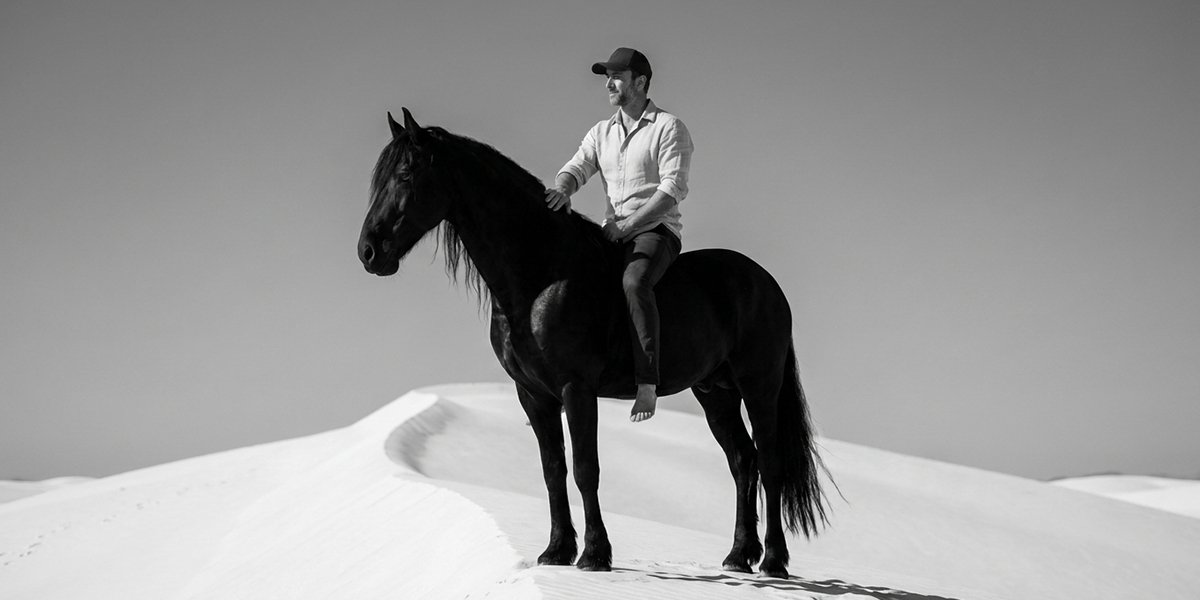
The collection that has made more strangers into collectors than any other in Macek’s body of work is Over the Dunes, the series he shot in the Emirates at dawn and dusk, with Arabian horses moving freely across the dune landscape that shaped their breed. The collection is entirely monochrome, and Macek is unambiguous about why: color makes the desert beautiful; black and white makes it honest. Strip color from the scene, and what remains is form. Pure, architectural, immediate. The curve of a spine echoes the curve of a dune. The dialogue between a living body and the void surrounding it.
Getting there took years. The horses Macek photographs in the Emirates are not stock animals. They are descendants of legendary bloodlines, kept by Emirati families with deep cultural attachments to the breed. Families whose trust cannot be purchased but must be earned. Macek, who describes himself as a quiet operator by nature, spent the time required to be welcomed. Then he went to the desert and waited.
The working method in the field is the same method he has always used, because it is the only method available to someone who does not direct his subjects. He watches. He reads the rhythms of the herd. He learns the wind. He waits for the light to do what he cannot ask it to do. The Emirati summer reaches 45 degrees Celsius. There are days when the only available accommodation is a tent. There are other days when he returns to a hotel in Dubai. Both, he insists, are necessary: the privation and the comfort are the alternating currents of a discipline that requires both to function.
The signature image of the collection, the one that stops strangers most reliably in galleries across the network, is called Arcus. A dark horse fills the foreground of the frame like a living archway, its legs forming pillars. Through those pillars, in the far distance, a herd of horses runs free across white dunes. Macek describes what the image contains: the protection, the intimacy, the window to something larger than any individual. It is an image that people stand in front of for a long time. And then they ask who made it.
“The dunes are never the same. Day after day, you discover something completely new.” – Raphael Macek
What Collectors Are Actually Buying
When the conversation that begins in front of Arcus, or any Macek, moves toward acquisition, what the collector is buying is something more layered than a beautiful image. They are buying a limited edition: twelve prints per size, never more. They are buying an archival object built to outlast the century. They are buying provenance documented in perpetuity by InnFRAME, the studio Macek founded, so that the chain of custody from camera to collector’s wall would never pass through hands he had not trained and trusted. They are buying a print that Macek has personally touched, inspected, and approved, something he has said plainly in private correspondence with collectors: “When you acquire a piece from my collection, you are acquiring something I have personally touched, inspected, and approved. It is a piece of my life’s work.”
Entry-level works in the collection begin at $6,500, with larger pieces in the size matrix exceeding $23,000. Galleries on three continents maintain consistent international pricing, reflecting the artist’s approach to managing his editions carefully across regions.
Macek’s role as Official Creative Ambassador for American Wild Horse Conservation adds a dimension that the commercial proposition alone cannot supply. The conservation work, which raises awareness for the wild herds of the American West and the political pressures they face, is not a side project or a cause affixed to a career for optics. It is, in Macek’s framing, the logical extension of the same conviction that produced the work in the first place: the horse made human civilization possible, and that debt has not been repaid.
The Phrase That Explains Everything
There is a line that appears in Macek’s captions, in his correspondence with collectors, in conversations at fairs and in galleries, and in nearly every public statement he makes. Real Will Always Be Rarer. On the surface, it reads as a brand line. Underneath, it is a precise description of the current cultural moment.
We are entering, have already entered, an era in which images are produced at near-zero cost by machines that have never stood in a desert at four in the morning, never waited for a piece of light that may not come, never spent a childhood at the feet of an animal learning how it moves and breathes and holds its weight. The visual culture of the next decade will be saturated with synthetic imagery. In that environment, the photograph that was actually made (by an actual human being, in an actual place, over an actual lifetime of preparation) holds a different kind of presence. What becomes scarce becomes precious. And what is real, in an economy of fabrication, is the rarest commodity of all.
This is what Macek has been building toward for twenty-five years, without knowing that the cultural context would eventually arrive to make the argument for him. The natural light. The 150-megapixel sensor. The cotton rag paper. The signed edition. The proprietary studio. The decades of relationship with a subject that cannot be prompted into existence. None of it was assembled as a market strategy. All of it was assembled as a conviction.
And the strangers keep stopping. In Greenwich and Dubai. In Miami and Madrid. In São Paulo and Singapore. They stop in front of the image, and something shifts, and they start asking questions. They were not collectors when they walked in. By the time they leave, the conversation has begun. That is the art of making collectors out of strangers.
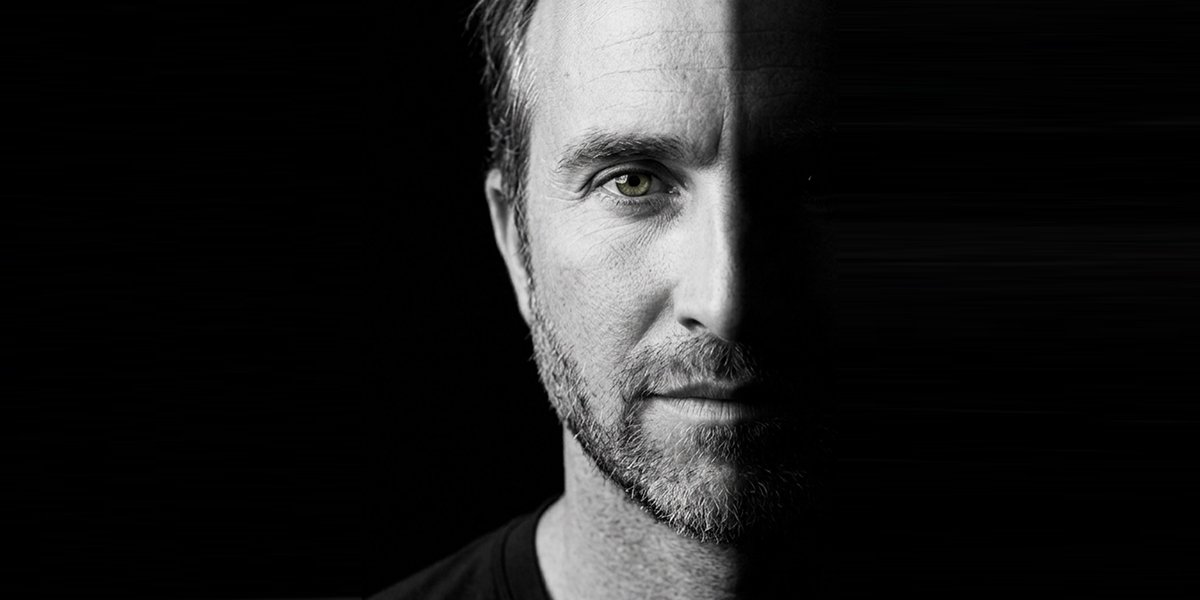
Raphael Macek is represented internationally by Raphael Macek Fine Art Group LLC. Works are held in private collections across more than thirty countries. Acquisition inquiries: raphaelmacek.com · gallery@raphaelmacek.com