
By: Ethan Rogers
There’s a position every toddler holds without thinking. Heels flat, knees out, hips fully closed, sitting at the bottom of a squat for as long as they like. It’s the default resting posture for a huge portion of the global population. It used to be the default for everyone. Somewhere between childhood and middle age, most Western adults lost it, and most of them don’t realize it’s gone.
Vanja (@vanja.moves), founder of movement education brand Moves Method, treats that single position as a diagnostic. Not a goal. Not a fitness benchmark. A read-out. If you can’t sit in a deep squat, something foundational about your relationship with your own body has shifted, and many of the everyday limitations adults notice in movement, from how it feels to pick up a box to how the body settles after a long flight, tend to live in that same territory.
The Squat As A Read-Out
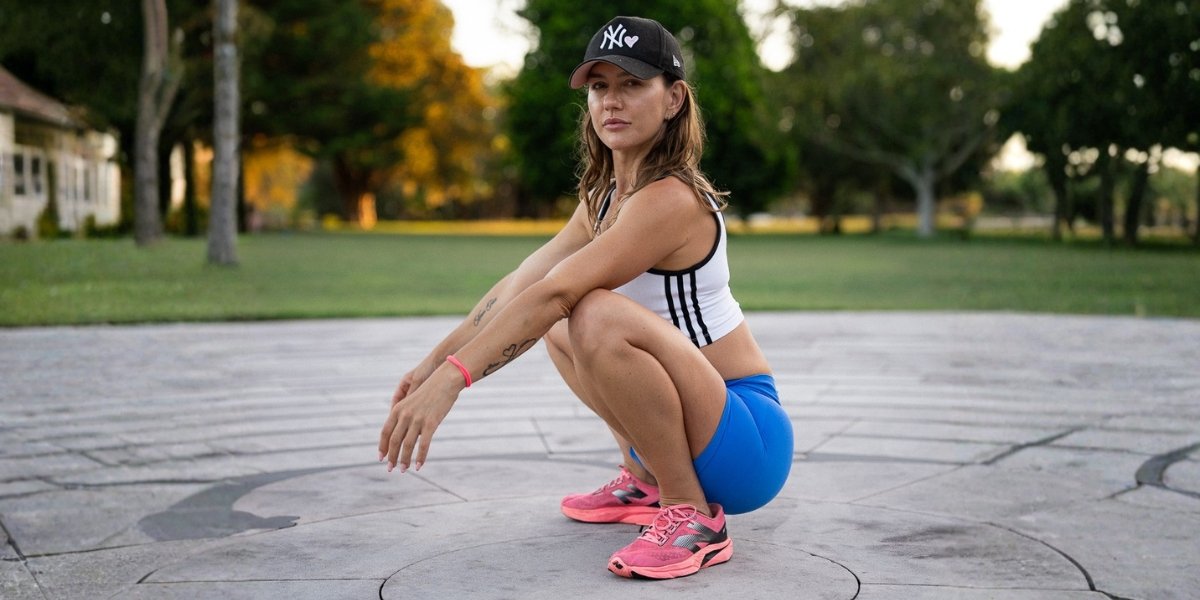
The deep squat (heels down, knees tracking out, torso upright, hips fully flexed) isn’t an exercise in Vanja’s methodology. It’s a position the human skeleton was built to occupy. When someone can’t access it, they’re not failing a fitness test. They’re missing a layer of their own physical operating system.
“The squat tells you, in ten seconds, where someone actually lives in their body. If they can’t go there, the rest of the assessment is just confirming what the squat already showed me.”
The hips don’t close. The ankles don’t dorsiflex. The spine can’t organize itself over the pelvis. And every movement that depends on those qualities, including bending, lifting, getting up off the floor, and sitting on the ground with a child, has to be compensated for somewhere else. That compensation, she argues, is where many adults run into the kind of everyday stiffness they assume is just part of getting older. A lower back that feels tight. Knees that feel guarded on the stairs. Hips that take time to loosen on a long flight. In her view, these patterns aren’t random. They’re what tends to follow when an architecture has stopped being able to fold.
What It Actually Means To Own A Body
Owning a body, in Vanja’s framing, means having access to the positions and patterns that the body was designed to produce. Being able to go where you need to go, hold what you need to hold, and move how you need to move without asking permission from a tight joint or a guarded muscle.
Most adults have stopped doing that. They train around the things they can’t do, instead of resolving them. The shoulder that won’t reach overhead gets a workaround in the form of incline work. The hip that won’t flex past 90 degrees gets a quarter squat with more weight on the bar. The body becomes a set of routes around its own restrictions, and the restrictions quietly become permanent.
“Mobility isn’t doing external rotations to fix your shoulder. Mobility is being able to crawl, hang, rotate, and load every position your body was built for. Most people are doing rehab on a body they’ve never actually inhabited.”
The squat, she argues, is the entry point to undoing that. Once the hips can fully close under load, hanging starts to feel different. Crawling becomes accessible. The spine remembers how to flex, extend, and rotate together. The body becomes literate in itself again. What looks like a single position is the doorway to a much longer reclamation.
Why Stretching Won’t Get You There
The standard advice for a stiff squat is to stretch more. Open the hips. Mobilize the ankles. Hold a deep position passively and wait for the tissues to release. The problem, in her view, is that passive stretching doesn’t teach the body anything it can keep. The new range shows up on a yoga mat and disappears the moment real demand arrives.
The path she teaches is the opposite. Strength through range. Loaded end positions. Active control of the very angles most people have only ever stretched into. A squat that can hold weight at the bottom is a squat the nervous system trusts, and a squat the nervous system trusts is one that stays available under load, under fatigue, under whatever a real day demands.
“A position you can perform is not a position you own. You own a position when your body can produce force from it.”
That distinction is most of the work. It’s also why most adults have spent years on mobility routines without getting any closer to a squat they can actually sit in.
What The Squat Is Really Asking
The deep squat isn’t a fitness goal. It’s a question the body is asking about whether it still belongs to its owner. Most adults have answered no for so long they’ve forgotten the question was being asked at all.
Reclaiming it, and the hanging, crawling, and full-range strength that build out from it, isn’t about getting better at the gym. It’s about repossessing parts of a body that modern life quietly took. Vanja describes working with clients in their 40s and 50s who, after decades of not being able to sit at the bottom of a deep squat, eventually can. When they do, she says they often talk about it less as a fitness milestone and more as something coming back online.
That’s what the squat is for, in her methodology. Not a measurement of how strong someone is. A measurement of how much of themselves they can still reach.