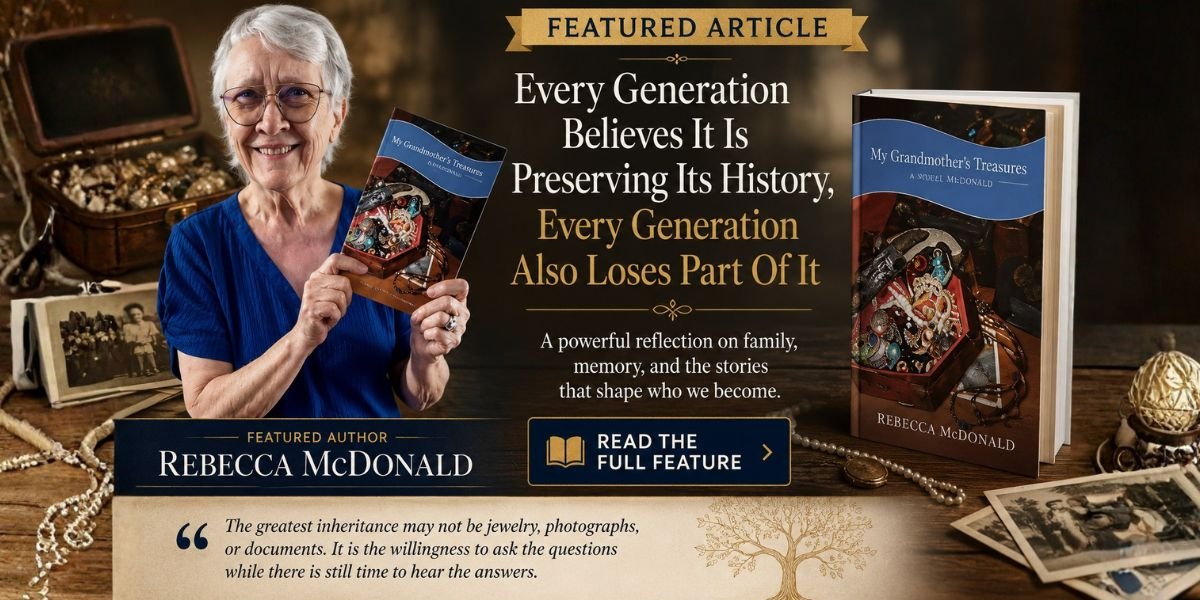

Every era believes it is racing toward the future. The most thoughtful ones occasionally remember to look back.
Contemporary culture has developed an unusual relationship with time. We celebrate innovation, reward immediacy, and treat the newest idea as inherently superior to the one that came before it. News cycles expire within hours. Trends survive for weeks. Even personal memories compete with endless streams of fresh distractions. History, meanwhile, waits patiently. Not because it cannot change, but because it asks something modern life rarely encourages: sustained attention.
This growing divide helps explain the renewed appeal of novels that place ordinary lives at the center of historical reflection. Rebecca McDonald’s My Grandmother’s Treasures belongs to this conversation, presenting family history not as a museum exhibit but as something intimate, emotional, and unexpectedly urgent.
As grandmother Cassie McAllister introduces her granddaughter, Tessa, to the stories hidden inside treasured pieces of jewelry, another family conflict quietly develops alongside those recollections, reminding readers that history never exists apart from the people who inherit it.
Past Has Become Personal Again
For much of the twentieth century, history often arrived as dates, wars, political movements, and famous names. The emphasis rested on national narratives, with individual families occupying only the margins. That perspective has shifted.
Genealogy has become a popular pastime. Old photographs inspire online communities devoted to restoring forgotten identities. Families increasingly search for immigration records, military documents, and handwritten letters to understand not only where they came from, but also why earlier generations made certain choices.
These pursuits suggest that people are no longer satisfied with official history alone. They seek stories that explain character instead of chronology.
McDonald’s novel reflects this desire. The family’s keepsakes matter less for their monetary value than for their ability to explain relationships spanning decades. Each object serves as evidence that ordinary people leave meaningful histories, even when history books overlook them.
Memory Is Never Neutral
One of the novel’s most compelling observations arrives not in its recollections but in its tensions. Cassie’s daughter, Vivian, questions her mother’s judgment, believing something is seriously wrong, while young Tessa finds herself caught between two women she loves without understanding the conflict separating them. The arrangement quietly challenges a comforting assumption about memory: that families preserve one shared version of the past. They rarely do.
Every generation edits its experiences differently. Parents soften difficult years for their children. Grandparents remember sacrifices that others barely noticed. Children grow into adults carrying interpretations their elders never intended. History, whether national or personal, emerges from these competing accounts rather than a single authoritative voice.
Perhaps that explains why family stories remain endlessly compelling. They acknowledge contradictions rather than eliminate them.
An Act of Cultural Preservation
Rebecca McDonald’s background as both an educator and a historian informs her fiction in subtle yet significant ways. Rather than placing celebrated historical figures at the center of attention, she invites readers to consider households, conversations, and relationships as equally worthy subjects of remembrance. That perspective feels especially relevant today.
As artificial intelligence summarizes information, algorithms recommend what comes next, and digital platforms compress attention into shorter intervals, literature continues performing a task no technology has fully mastered. It restores context. A family argument becomes inseparable from decades of shared experience.
A forgotten necklace acquires emotional significance because someone remembers the hands that once wore it. A granddaughter finds out that understanding her family’s past may require accepting its imperfections rather than resolving them.
There is quiet reassurance in that idea. Progress does not require abandoning memory, nor does honoring the past demand resisting change. The healthiest societies recognize that innovation and remembrance belong to the same conversation.
Takeaway
Novels like My Grandmother’s Treasures suggest that history survives most faithfully when it is carried not only by institutions, but also by families willing to keep asking questions. Long after headlines disappear and technologies become obsolete, those conversations remain among the few inheritances capable of outlasting every generation that tells them.