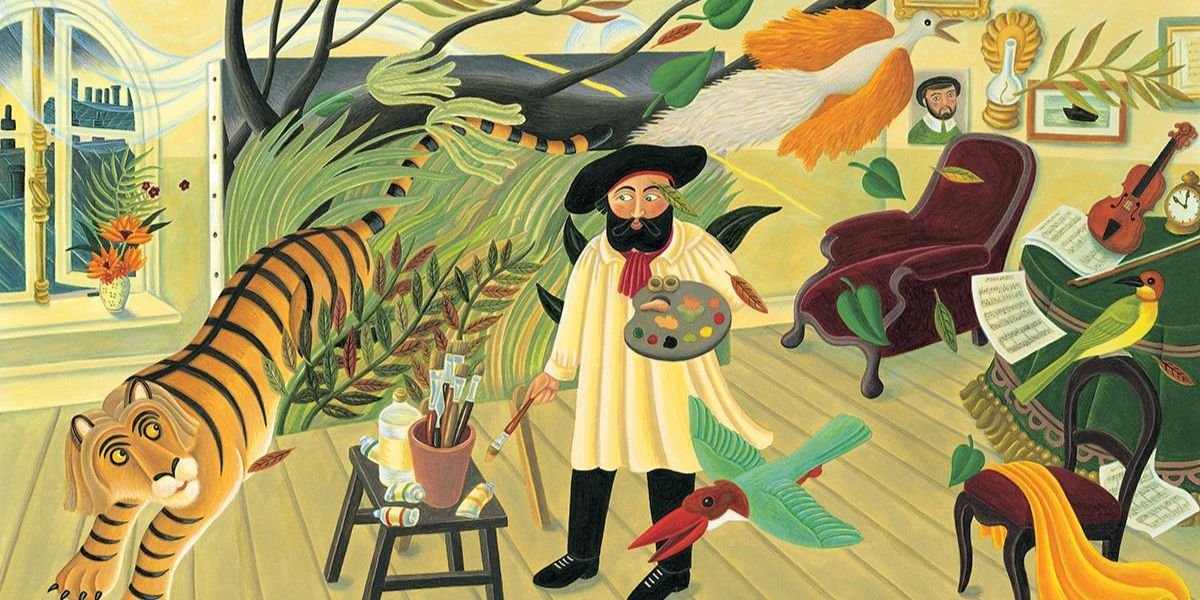

Illustration in the realm of children’s publishing is a complex interplay between narrative, design, and process. Over the past several decades, illustrations have employed a variety of media that blend traditional hand-produced processes with digital methods to create visual elements that enhance the written narrative. The traditional picture book provides a framework for interpretation that extends beyond literal depiction, shaping the reader’s engagement with the narrative’s pace and meaning. In the context of this framework, the work of British illustrator-author Amanda Hall serves as a case study for developing a consistent style that accommodates various forms of collaboration and production.
Hall’s artistic method is grounded in a mixed media approach, with watercolor inks combined selectively with colored pencil, pastel, gouache, acrylic, or digital processes. Rather than applying all media in every illustration, she chooses combinations appropriate to each image. The graduated accumulation of different tones creates depth and tonal variation, giving the impression that elements project forward from the flat page. This approach produces compositions that are dense and visually rich, generating an almost three-dimensional effect. This technique has been evident throughout her work from the late twentieth century through her most recent publications.
Her approach to space and structure also moves away from realism, in that rather than using light and shadow to define form, she often uses other methods, such as contour, tone, and composition, to define the relationship between components in the image. This creates a series of images that are immediately comprehensible at a glance, but which also offer additional visual information on closer inspection. This creates a sense of layer in the reading process, where the viewer moves from foreground to background, often without direct reference in the accompanying text. This is in keeping with a wider tradition in the illustration of the picture book form, where images are used in a significant way in the telling of the story.
A key reference point in discussions of Hall’s visual language is Henri Rousseau’s work. Rousseau’s paintings are known for their flattened perspective, stylized vegetation, and symbolic treatment of space and scale. Hall encountered his work during her art studies in the mid-1970s, including the 1897 painting The Sleeping Gypsy. This moment has been described as a moment of recognition rather than imitation, in which she identified parallels between her own instincts and Rousseau’s approach. The influence is evident in her use of strong outlines, defined shapes, and a compositional logic that prioritizes clarity over optical realism.
This affinity does not lead to direct quotation of Rousseau’s imagery other than when required by the text to playfully reference three of Rousseau’s actual paintings in The Fantastic Jungles of Henri Rousseau, but it does influence the structure of Hall’s work. Characters and objects are frequently placed in a way that suggests a stage-like environment. In such cases, the size of objects and the spatial depth are frequently compressed. This allows narrative elements to be placed within a single frame without adhering to a strict physical point of view. In this context, it is possible to see how the image works as a setting rather than a view of a consistent reality. This can be seen within both commissioned and independently developed works.
When working within the picture book format, Hall’s work often explores the boundaries of the page as an environment. The visual elements extend beyond the immediate requirements of the text, including secondary actions or objects. These do not contradict the narrative but instead expand it, providing a further dimension of meaning. This requires a careful balance. Too much visual information can overwhelm the reader, while too little can limit engagement. Hall’s work reflects an ongoing negotiation between these positions, shaped by the nature of each project.
This difference between commissioned work and speculative collaboration is an important factor in the way this balance is achieved. In a publisher-led commission, the text is usually complete before the illustrator starts work. In this case, Hall’s work is the interpretation of a given text, with some visual autonomy allowed. However, in speculative collaborations that are developed before submission, the relationship between text and image is not fixed. This is particularly evident in projects initiated with writers prior to publisher engagement, which allow for a more integrated development process.
Hall’s role as an author-illustrator further extends this integration. In works such as Song of the Raven, she is responsible for both narrative and imagery, allowing for a unified conceptual approach. The absence of a separate writer removes the need for negotiation between two creative voices. However, it also concentrates decision-making within a single perspective. This dual role reflects a broader trend in children’s publishing, where some illustrators move into authorship to gain greater control over the structure and content of their work.
While Hall’s book illustration is not characterized by repeating patterns, recent developments in her practice indicate an expansion into surface design and merchandising. Since around 2012, imagery derived from her illustrated work, particularly The Fantastic Jungles of Henri Rousseau, has been used in products such as wall art and apparel. In this context, she has begun to develop repeat designs, a format distinct from the narrative demands of picture books. This shift reflects a change in how illustrated content can circulate, moving from the page into applied design contexts.
Hall has established a way of working that has remained consistent throughout her career, despite working with different production methodologies. The use of mixed media, the referencing of historical and geographical imagery, and her working relationships with different production partners have all helped establish her as someone with a unique visual style. The work she has been creating in the field of surface design also indicates that she is aware of the potential of illustration beyond the printed page.
Amanda Hall’s practice illustrates how an illustrator can sustain a coherent visual method across changing contexts, from traditional publishing to newer forms of design application. Her work continues to engage with the fundamental question of how images and text interact, while adapting to the evolving conditions of the children’s book industry.