
By: Lennard James
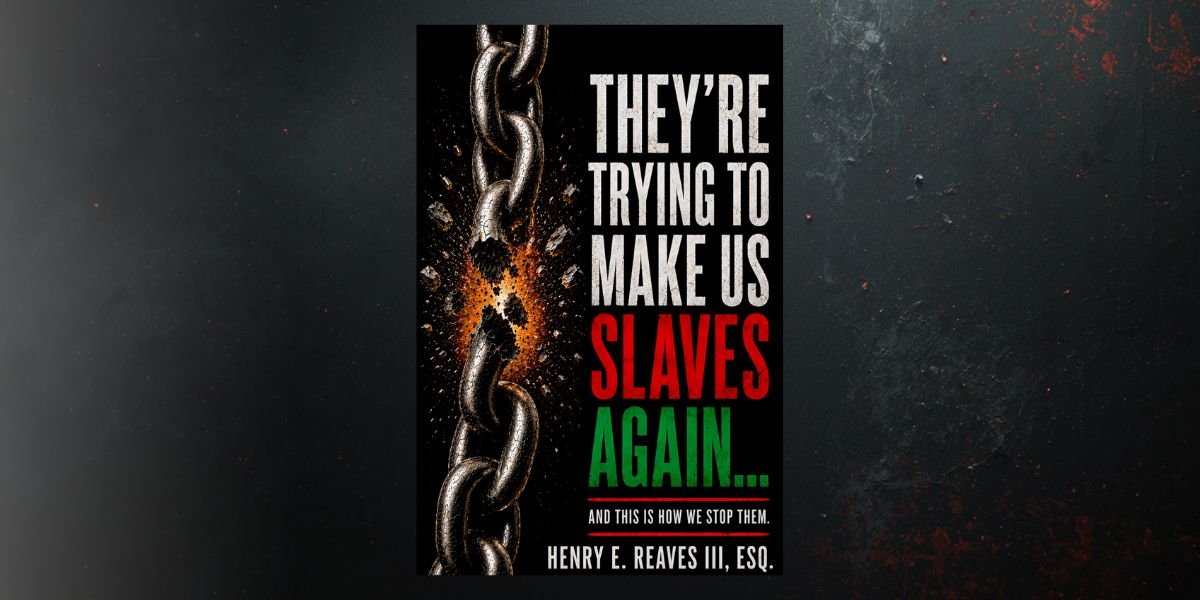
In his book, They’re Trying to Make Us Slaves Again: This Is How We Stop Them, Attorney Henry E. Reaves III, Esq. delivers a direct message to communities searching for solutions to generations of economic exclusion, discrimination, political struggle, mass incarceration, and other barriers to progress: identifying the problem is no longer enough. It is time to organize around solutions.
The book begins from a historical reality spanning approximately 400 years, moving through slavery, segregation, discrimination, economic exclusion, and mass incarceration. But Attorney Henry E. Reaves III, Esq. does not present the book simply as another examination of history or racism. Instead, he describes it as a practical blueprint centered on what individuals and communities can do to help shape their future.
“This book is different. This book is a solution,” the book declares.
That distinction is central to the message of Attorney Henry E. Reaves III, Esq. Many books have documented historical injustices and examined racism from different perspectives. His approach is focused on moving from diagnosis to action by presenting a strategy built around Ten Steps addressing education, political power, economic ownership, family restoration, faith, and institution building.
The objective is not merely to discuss what should happen. The book is presented as a strategy for how meaningful change can be pursued.
Economic Ownership and Community Strength
That solutions-oriented approach makes economic ownership particularly important. Communities may struggle to achieve sustainable independence through income alone. Building stronger neighborhoods can require creating and supporting businesses, developing assets, strengthening families, investing in education, building institutions, and increasing the ability of communities to influence their economic futures.
Economic strength can also create opportunities beyond the individual. A successful business can employ residents. Property ownership can establish an asset that survives for generations. Financial knowledge can change how a family approaches money. Strong community institutions can provide resources, leadership, education, and opportunities long after their founders are gone.
For Attorney Henry E. Reaves III, Esq., these pieces must work together.
Civic Participation and Lasting Progress
His blueprint also recognizes political power as an important component of lasting progress. Economic development and civic participation frequently intersect. Decisions involving schools, neighborhoods, public investment, business development, criminal justice, housing, and community resources are influenced by public policy.
The book therefore calls for communities to understand the systems affecting their lives and become active participants in shaping those systems.
Family restoration and faith are also incorporated into the Ten-Step framework. By including them alongside education, economics, and civic engagement, Attorney Henry E. Reaves III, Esq. presents community development as more than a financial challenge. Stronger communities require stronger people, families, values, institutions, and relationships.
SONU and Project 2035
At the center of the strategy outlined in the book is SONU, Save Our Neighborhoods United, an organization established to help execute the Ten Steps and advance Project 2035, an initiative described in the book as a plan to pursue long-term freedom and community empowerment by the year 2035.
This is where the book attempts to distinguish itself from traditional social commentary. The objective is not simply to inspire readers and then leave them wondering what comes next. The Ten Steps, SONU, and Project 2035 are presented as vehicles for converting ideas into organized action.
“This is not a history lesson. It is a playbook. Not a diagnosis. A cure,” the book states.
A Role for Every Part of the Community
That playbook is directed toward a broad audience. Attorney Henry E. Reaves III, Esq. addresses parents, pastors, teachers, coaches, community leaders, elected officials, and young men and women searching for purpose. The underlying message is that rebuilding communities cannot be delegated to one profession, organization, political party, institution, or generation.
Everyone has a role.
Parents can teach values and financial responsibility. Educators can prepare young people academically and professionally. Business owners can create employment and mentor emerging entrepreneurs. Faith leaders can strengthen families and communities. Elected officials can advocate for policies that expand opportunity. Community organizations can connect people with resources. Young people can prepare themselves to become the next generation of owners and leaders.
The broken chain depicted on the book’s cover provides a visual representation of that philosophy. A chain may symbolize restriction, but a broken chain represents the possibility of overcoming it. The image suggests that progress requires collective strength to address what has historically limited communities.
A Blueprint Informed by Experience
The professional experiences of Attorney Henry E. Reaves III, Esq. also inform the perspective behind the book. He is described as an attorney, entrepreneur, Emmy Award-winning filmmaker, military veteran, and community leader. Those different experiences contribute to a blueprint that looks at community empowerment from multiple directions rather than through a single lens.
Ultimately, They’re Trying to Make Us Slaves Again: This Is How We Stop Them is built around urgency.
Attorney Henry E. Reaves III, Esq. argues that communities cannot afford to spend another generation exclusively discussing problems while failing to construct the institutions, economic systems, educational opportunities, family structures, and civic influence necessary to pursue meaningful change.
The problems, the book says, are urgent.
The solutions must be treated with the same urgency.
And perhaps the most concise expression of the philosophy behind Attorney Henry E. Reaves III, Esq. and his book appears in its closing message:
“Freedom is not given. Freedom is organized. Freedom is built.”