
Business travel can put you in some of the world’s most interesting cities. What you do outside the workday can turn the trip into something more.
Josh Vignona’s BizLeisure trip through Florence and Rome focused on history, architecture, and local food. His time in both cities included some of Italy’s best-known landmarks, along with regional dishes that are part of everyday Italian culture.
Rome brought ancient history through the Colosseum and Roman Forum. Florence offered Renaissance architecture at the Duomo Complex and Giotto’s Bell Tower. Along the way, Joshua Vignona explored both cities through their neighborhoods and food.
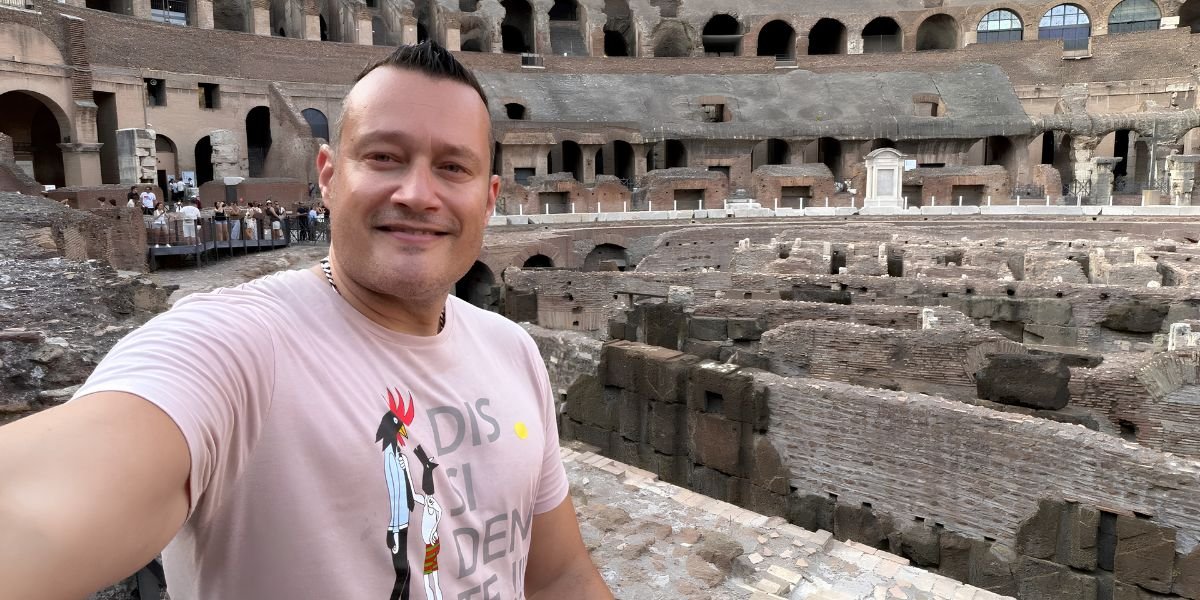
Josh Vignona Visits the Colosseum
The Colosseum remains one of Rome’s most recognizable landmarks and one of the best places to see the scale of the ancient city.
Construction began under Emperor Vespasian around AD 70 to 72, and the amphitheater was dedicated under his son Titus in AD 80. It became known for gladiatorial contests and other public spectacles attended by large Roman crowds.
Walking through the Colosseum gave Josh Vignona a close look at how the amphitheater operated. Its surviving corridors, seating areas, and underground structures show the planning required to stage events there.
Gladiators, animals, workers and equipment moved through a complex system beneath and around the arena. Seeing those spaces in person makes it easier to understand how large and organized the spectacles were.
The Colosseum has survived earthquakes, stone removal, and centuries of change. Its remaining structure still provides a direct look at Roman engineering and public entertainment.
Joshua Vignona’s visit also offered a closer look at the world associated with Rome’s gladiators. Standing inside the amphitheater puts that history into a physical setting rather than leaving it on the pages of a history book.
Walking Through the Roman Forum
A short distance from the Colosseum, the Roman Forum shows another side of ancient Rome.
The Forum served as a center of political, religious, and commercial activity. Temples, government buildings and public spaces once stood together in an area used by Roman leaders and citizens.
Walking through the site gives visitors a sense of how the ancient city functioned. Columns, arches and foundations mark spaces once used for government, religion and commerce.
The location also works well for BizLeisure travel. Josh Vignona could move between the Colosseum and Roman Forum without spending a large part of the day traveling between attractions.
That concentration of historic sites makes Rome easier to explore when time is limited. Once outside the archaeological areas, the city’s neighborhoods offer a different experience.
Josh Vignona Explores Trastevere and Rome Through Food
Food was another part of Joshua Vignona’s time in Rome.
A VIP food tour through Trastevere and Rome’s Historic Center provided a look at the city beyond its major monuments. Trastevere’s narrow streets, restaurants, and neighborhood setting made it a natural place to experience Roman food.
The tour also offered a chance to try authentic pasta dishes in the city known for them.
Roman pasta often relies on a short list of ingredients and careful preparation. The simplicity puts more attention on the quality of the ingredients and how the dish is prepared.
Eating those dishes in Rome gave Josh Vignona a different view of the city after visiting the Colosseum and Roman Forum. The historic sites show ancient Rome, while Trastevere and the Historic Center show the city through its streets, restaurants, and food.
That mix of history and local dining made the Rome portion of the trip about more than its famous monuments.
Florence Starts With the Duomo Complex
Florence brought a shift from ancient Rome to Renaissance Italy.
Josh Vignona visited the Duomo Complex, one of the defining landmarks in Florence’s historic center. The Cathedral of Santa Maria del Fiore is immediately recognizable by Filippo Brunelleschi’s dome, which dominates the city’s skyline.
The complex brings together architecture, engineering, art, and religious history in the center of Florence.
Up close, the scale and detail of the cathedral become much clearer. Its exterior is highly detailed, while Brunelleschi’s dome remains one of the building’s defining architectural features.
The Duomo also reflects the period when Florence became a major center of Renaissance art, architecture, and design.
The next stop offered a different view of the same historic center.
Climbing Giotto’s Bell Tower
Giotto’s Bell Tower stands next to the Duomo and is another major part of Florence’s cathedral complex.
The Gothic bell tower is known for its detailed exterior and views over Florence. Reaching the top requires climbing hundreds of steps, but the height provides a broad view across the historic center and a close look at Brunelleschi’s dome.
Visiting the Duomo Complex and Giotto’s Bell Tower showed Joshua Vignona how much of Florence can be experienced within a relatively compact area.
Major landmarks, public squares, and restaurants are close enough that travelers can spend more time exploring and less time moving across the city.
That walkability continued at another of Florence’s best-known public spaces.
Exploring Piazza della Signoria
Josh Vignona also explored Piazza della Signoria, a square closely tied to Florence’s civic and political history.
Palazzo Vecchio anchors the piazza, while sculptures and surrounding buildings reflect the city’s artistic history. The square has served as an important public space in Florence for centuries.
Its central location makes it an easy addition to a walk through the historic center. Visitors can move between major landmarks while seeing the streets and public spaces that connect them.
Piazza della Signoria added another piece to Joshua Vignona’s experience of Florence. The Duomo and Giotto’s Bell Tower highlighted the city’s architecture, while the piazza offered a look at its civic and public life.
Food provided the next part of the Florence experience.
Tuscan Food in Florence
Josh Vignona’s time in Florence included Tuscan food, authentic pasta, high-quality olive oil, and Bistecca alla Fiorentina.
Bistecca alla Fiorentina is one of the dishes most closely associated with Florence. The thick-cut steak is prepared simply, putting the focus on the meat and its preparation.
Olive oil is another important part of Tuscan cooking. High-quality olive oil is used throughout the region and often served with simple foods that allow its flavor to stand out.
Pasta added another part of the local dining experience. Eating authentic pasta dishes in Florence gave Joshua Vignona the chance to experience Italian cooking in the region where those culinary traditions are part of daily life.
The food in Florence complemented what he experienced in Rome. Each city had its own landmarks, neighborhoods, and local dishes.
Florence and Rome Beyond the Workday
Josh Vignona’s BizLeisure trip combined two distinct parts of Italy.
Rome centered on the Colosseum, Roman Forum, Trastevere, and the Historic Center. Florence included the Duomo Complex, Giotto’s Bell Tower, Piazza della Signoria, and Tuscan food.
The two cities also work well for travelers with limited free time. Many of their major attractions are concentrated in historic centers that can be explored on foot.
BizLeisure does not require adding a long vacation to a work trip. A few well-planned hours or extra days can be enough to visit major sites, walk through local neighborhoods, and try food associated with the destination, the same practical mindset behind Vignona’s guidance on staying productive while working remotely.
Joshua Vignona’s time in Florence and Rome did exactly that, combining ancient and Renaissance history with the food and streets of two of Italy’s most distinctive cities.