
By: Rachel Corbin
There is something suspiciously unfashionable about Eddy Mann calling a song “We Are.”
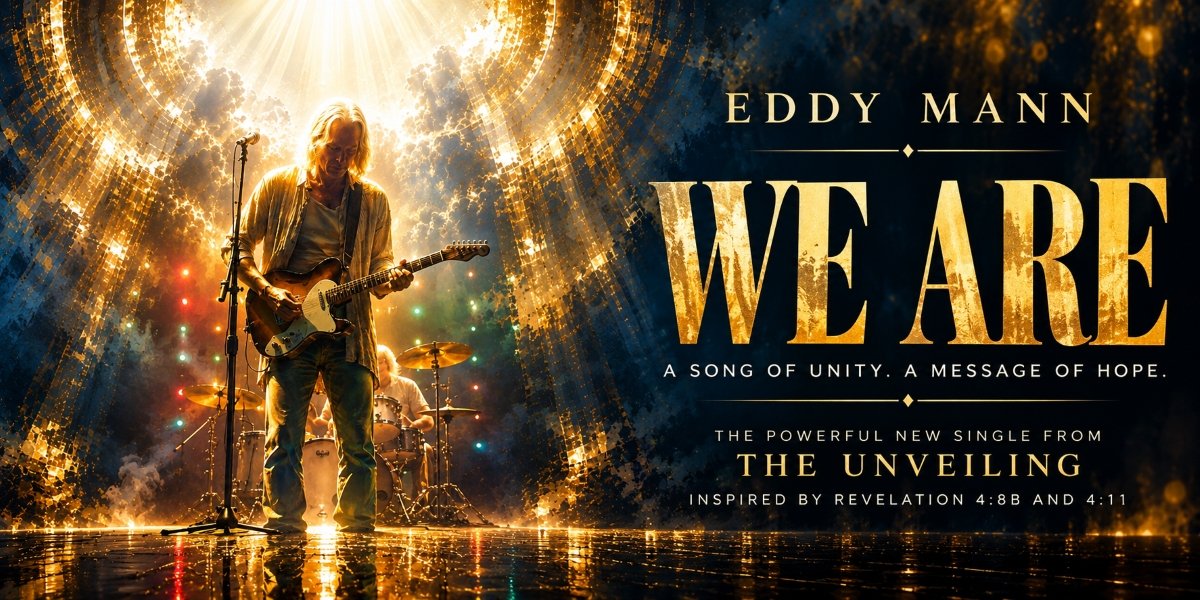
Not I Am. Not This Is Me. Not the language of personal empowerment, self-realization, or therapeutic affirmation that contemporary culture has become remarkably adept at selling back to audiences. Mann chooses the plural. And on “We Are,” his jazz-inflected worship single from The Unveiling, that tiny grammatical decision becomes the center of everything.
“We are Your will / We are Your desire / We are Your pleasure,” Mann sings.
It’s a religious statement, obviously. But it’s also a social one.
Popular music has always maintained a complicated relationship with individualism. Rock built its mythology around rebellion and personal liberation. Pop turned identity into spectacle. The singer-songwriter tradition made private feeling public currency. Even contemporary worship music often borrows pop’s individual vocabulary: I believe, I surrender, I need, I praise.
Mann insists upon we.
This wouldn’t matter much if the music surrounding the idea were conventional. But “We Are” is written in 5/4, a meter uncommon enough in contemporary worship to seem almost confrontational.
Mann says it wasn’t intentional. The song originated during a quiet devotional encounter with Revelation 4 and simply settled into five beats.
That’s interesting because the record doesn’t sound difficult. Listeners don’t need a music degree or a Dave Brubeck collection to understand it. The unusual meter works almost subliminally, creating the feeling that the ground beneath the song is slightly uneven.
Four beats promise stability.
Five introduces another step.
For a song about faith, that’s appropriate.
Mann’s source material is Revelation 4:8b and 4:11. Revelation is a peculiar cultural artifact even before one gets to theology. For generations it has been used to explain wars, elections, natural disasters, technology, geopolitical enemies, and whatever else frightened people at a particular historical moment. Popular culture has enthusiastically borrowed its beasts, horsemen, fire, and cosmic violence.
Mann isn’t interested in any of that.
He hears worship.
“Holy, holy, holy / Is the Lord Almighty,” he sings, beginning with language so familiar within Christianity that it risks becoming invisible through repetition.
But Mann’s larger project with The Unveiling has been to make familiar Scripture strange enough to reconsider. He approached Revelation and, rather than discovering a divine horror movie, found evidence of compassion, endurance and hope.
“We Are” may be the album’s clearest expression of that interpretation.
The song’s central claim, that human beings are God’s will, desire and pleasure, is almost provocatively affirmative. Christianity has frequently emphasized humanity’s fallen condition. Mann doesn’t necessarily dispute that theology; he simply begins somewhere else.
Creation.
Purpose.
Belonging.
And this is where “We Are” becomes more interesting than its designation as “Christian jazz” or “contemporary worship” might suggest.
Mann has said he believes in brotherhood and sisterhood and worries about rhetoric that continually nourishes separation. It’s easy enough to agree with that sentiment abstractly. “Unity” is one of those words everybody endorses until somebody asks what it requires.
Actual community is inconvenient.
It requires recognizing people who are disliked as human beings. It means accepting difference without converting every disagreement into exile. It demands something beyond posting inspirational slogans about togetherness.
Mann doesn’t solve that problem. A four-minute song couldn’t.
But he identifies the spiritual contradiction underneath it.
If people are God’s creation, the term cannot conveniently apply only to those who resemble them.
The music reinforces that argument in an unexpectedly effective way. Jazz has always depended upon the tension between individual freedom and collective responsibility. The player is encouraged to develop a recognizable voice, to sound unlike everyone else, but must simultaneously listen to everyone else.
Without individuality, jazz becomes lifeless.
Without listening, it becomes chaos.
That’s a considerably more interesting model of unity than conformity.
Mann’s performance reflects the patience of an artist who has been doing this long enough to distrust spectacle. He doesn’t sing as if he needs to overwhelm the listener into belief. There is no enormous production maneuver announcing the arrival of transcendence.
The record breathes.
That restraint separates “We Are” from a strain of contemporary worship that borrows the mechanics of arena rock while stripping away rock’s danger. Quiet verse. Gradual build. Exploding chorus. Repeat. Raise hands.
Mann takes the opposite approach.
His odd meter is adventurous, but his delivery is calm. His theology is enormous, but his lyric is economical. His subject is Revelation, but his record refuses apocalypse.
Those contradictions give the song life.
They also make “We Are” distinctly Mann’s. After decades spent moving between songwriting and ministry, he has little apparent interest in disguising his musical eccentricities for the sake of fitting a format. He’s spoken about God as his “audience of One,” which could sound like the ultimate rejection of criticism. Here, however, it sounds more like liberation from market anxiety.
The song doesn’t have to behave.
So it counts to five.
It borrows from jazz.
It repeats ancient words.
And it keeps returning to we.
The radical possibility inside “We Are” isn’t that everybody might someday agree. That would be both impossible and unbearably dull.
It’s that perhaps agreement was never the prerequisite for belonging.
Mann’s song doesn’t preach that argument so much as quietly embody it: individual musical language placed in service of collective identity.
Five beats instead of four.
Many voices instead of one.
Not I am.