
By: Jasmine Reynolds
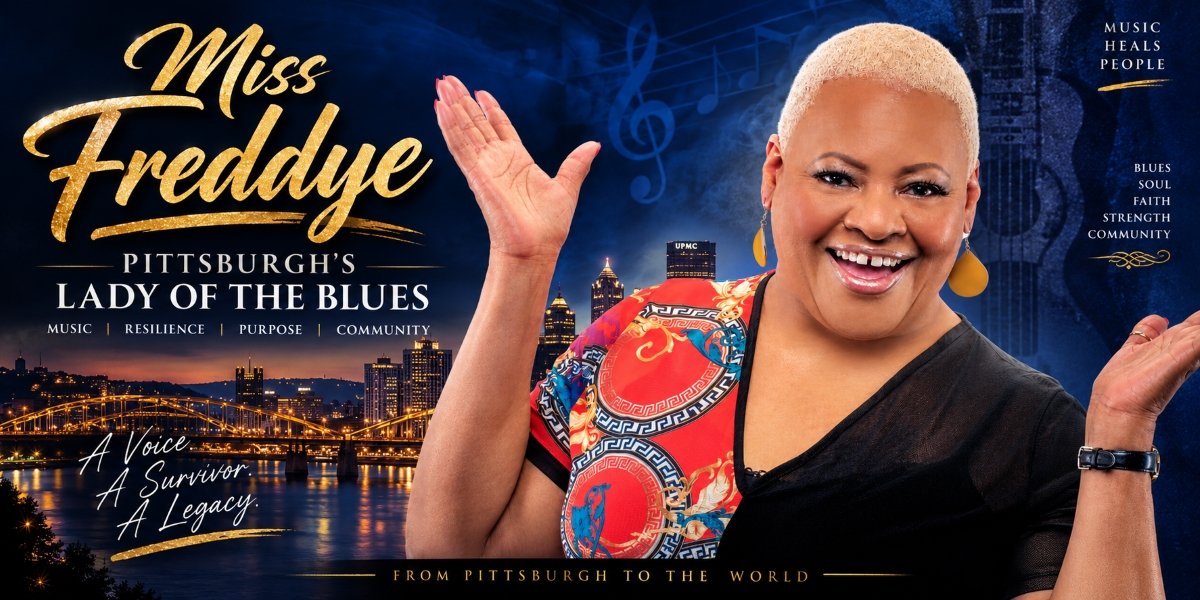
Success stories in music are often packaged around the breakthrough: the viral song, the record deal, the moment everything supposedly changed overnight. Miss Freddye’s career offers a more meaningful alternative. Pittsburgh’s celebrated “Lady of the Blues” has built her legacy over decades through consistency, community, reinvention, and an extraordinary ability to transform personal adversity into connection.
Today, Miss Freddye is an award-winning, internationally charting blues artist. But long before the accolades arrived, she was building a life centered on service.
Growing up with gospel music as an important influence, Freddye learned early that a powerful voice means little unless there is something behind it. Gospel taught her to communicate emotion rather than simply perform it. That lesson eventually became central to her identity as a blues singer.
Her professional journey into the blues began in the 1990s. She became involved with Pittsburgh’s blues community and gradually developed into a commanding live performer. By the early 2000s, she was leading her own musical projects, eventually becoming known throughout western Pennsylvania simply as Miss Freddye.
The nickname “Pittsburgh’s Lady of the Blues” followed, and it fit.
Yet music was only one part of an already remarkable life.
Miss Freddye spent more than 30 years working as a nurse. While pursuing music, she was simultaneously caring for patients, raising a family, and navigating the responsibilities that rarely make their way into glamorous artist biographies.
That experience became part of her greatest strength.
There is empathy in Miss Freddye’s music because empathy has been central to her life. When she sings about struggle, listeners hear experience behind the words. When she sings about hope, it doesn’t sound like a slogan.
Then came some of her most difficult challenges.
Miss Freddye battled breast cancer not once, but twice. She also survived COVID. Those experiences could easily have caused her to retreat. Instead, they reinforced a philosophy that has come to define both her music and public presence: life is meant to be lived with purpose.
That philosophy can be heard throughout her recordings.
Blues remains at the center, but gospel and soul are never far away. Her voice can move from commanding and gritty to warm and vulnerable, carrying traces of the great women who helped establish the blues tradition while remaining unmistakably her own.
Her audience began expanding well beyond Pittsburgh.
Miss Freddye achieved international chart recognition, including reaching No. 1 on the UK iTunes Blues Chart. Her rendition of the traditional spiritual “Wade in the Water” demonstrated another dimension of her artistry, climbing to No. 2 on an iTunes gospel chart and reconnecting her contemporary career with the gospel foundation that helped shape her.
For an independent artist working in a heritage genre, those accomplishments are significant. They demonstrate something that has become increasingly important in today’s decentralized music industry: an artist doesn’t need to abandon authenticity to reach a global audience.
Awards and recognition have reinforced that point.
Miss Freddye has earned multiple honors within Pittsburgh’s music community, including Iron City Rocks recognition, while her recordings and performances have received acclaim from the broader blues world. Her Lady of the Blues project became particularly important in establishing her identity beyond the regional circuit and reinforcing the title that has become synonymous with her career.
Yet viewing Miss Freddye exclusively through awards and charts misses the larger lesson of her journey.
Her career is really about longevity.
In an industry obsessed with youth and instant visibility, she represents the power of building something gradually. Every concert, recording, interview, charitable appearance, and conversation with a listener has contributed to a personal brand without ever needing to call itself one.
That authenticity is increasingly valuable.
Miss Freddye has also understood that influence comes with responsibility. Her experiences as a nurse and cancer survivor have helped shape her commitment to charitable work and advocacy. She has supported cancer-related causes, veterans, community initiatives, and organizations addressing domestic violence, using music as a vehicle for something larger than career advancement.
Pittsburgh remains at the center of everything.
While her recordings have traveled internationally, Miss Freddye continues to embrace the city that helped build her. Pittsburgh’s blue-collar identity, its toughness, loyalty, humor, and ability to reinvent itself, feels almost inseparable from her own story.
Perhaps that is why “Pittsburgh’s Lady of the Blues” has become more than clever branding.
She earned it.
After decades in music, Miss Freddye can point to chart positions, awards, recordings, stages, and critical recognition. But her most significant achievement may be the community she has created around her music.
Fans don’t simply hear a blues singer. They encounter a woman who has cared for others, confronted serious illness, raised a family, pursued a dream, endured setbacks, and continued showing up.
That makes Miss Freddye’s career particularly relevant now.
Her story suggests that success does not have an expiration date, reinvention doesn’t require abandoning your identity, and influence is ultimately measured by what you give people, not simply how many people are watching.
For Miss Freddye, the blues has always been about telling the truth.
After nearly three decades, that truth is still being heard.