
Authors frequently assume that once their book has been through a round of editing, it must be clean and error-free, ready to publish. It is not. Editing and proofreading are genuinely different jobs with different purposes, and skipping the second one leaves behind exactly the kind of small errors that editing was never designed to catch. This misunderstanding is one of the most common reasons why otherwise professional books reach readers with typos still in them. The author believed editing had already covered it.
This article explains the real difference between editing and proofreading, why each requires a distinct mindset and a separate pass, and why a finished book needs both rather than one or the other. It covers what editing actually does, what proofreading catches that editing misses, and why treating proofreading as a distinct final stage is essential. For any author preparing to publish, understanding the difference between book editing services and book proofreading services is what prevents avoidable errors from slipping through into the finished book.
Editing and Proofreading Are Different Jobs
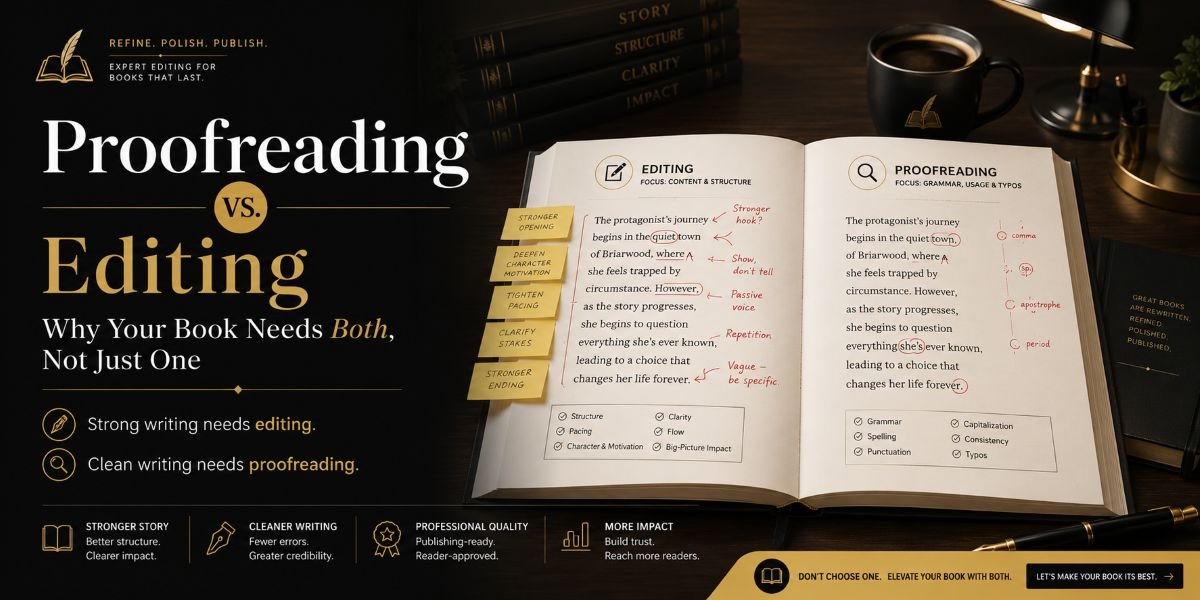
The core distinction is one of purpose. Editing is about improvement. It reshapes structure, sharpens sentences, strengthens clarity, and elevates the quality of the writing itself. An editor is actively working with the substance of the book, making changes and suggestions to make it better. Proofreading is about verification. It is a meticulous final sweep to confirm that the polished manuscript is mechanically clean and free of surface errors. The proofreader is not trying to improve the writing; they are confirming it is correct.
Because these are different goals, they require different mindsets and happen at different stages. Professional book editing is creative and analytical, engaging with what the book says and how well it says it. Manuscript proofreading is precise and detail-focused, scanning for the small mechanical slips that have nothing to do with the quality of the ideas. Expecting a single pass to accomplish both is unrealistic, which is why professional publishing treats editing and proofreading services as separate steps rather than folding one into the other and hoping for the best.
What Editing Leaves Behind
Even an excellent edit can leave small errors in a manuscript, and this surprises authors who assume editing catches everything. A thorough edit reshapes and refines the writing, but in the process of working with the substance of the text, an editor focuses on clarity, flow, structure, and correctness at the level of meaning, not on hunting for every stray double space, every minor typo, or every tiny punctuation slip. Catching those is not what editing is for, and the act of editing can even introduce new small errors as text is changed.
This is precisely why a finished, edited manuscript still needs a dedicated proofread. The editing has done its job of making the writing strong, but a separate, focused pass is required to confirm that the polished text is also mechanically clean. Lumera Publishing provides that dedicated final proofread, giving the manuscript the exacting, error-hunting attention that editing, by its nature, does not supply. Without professional proofreading for authors, a writer risks publishing strong writing marred by the very small mistakes they assumed had already been handled.
What a Dedicated Proofreader Catches
A proofreader targets the specific category of errors that survive writing and editing: spelling mistakes, punctuation slips, spacing problems, inconsistent formatting, and the small, leftover errors that are easy to read straight past. These are the kinds of issues a reader notices instantly when they appear in a published book, even though they have nothing to do with the quality of the story or ideas. A single glaring typo can pull a reader out of an otherwise excellent passage.
Crucially, a proofreader catches these things without changing the author’s meaning or style. The job is to correct mechanical errors, not to rewrite or reinterpret, so the author’s voice and intent remain exactly as the editing left them. Lumera Publishing’s book proofreading services give the manuscript that fresh, meticulous final read, confirming it is clean and ready while leaving the substance untouched. This focused verification is the last line of defense against the small errors that would otherwise undermine an author’s professionalism in the eyes of readers.
The Cost of Skipping the Final Proofread
When authors treat editing as the last step and skip a dedicated proofread, the errors that slip through do not stay hidden. They surface in front of readers, reviewers, and anyone evaluating the book professionally. A handful of typos scattered through a manuscript can be enough for a reader to mention them in a review, and a single prominent mistake on an early page can color how the entire book is perceived. The cost of skipping the final pass is rarely visible at the time and almost always visible afterward, once the book is in circulation and nothing more can be changed.
What makes this particularly avoidable is how small the remaining step is relative to the risk it removes. By the time a book has been written and edited, the overwhelming majority of the work is already done. The final proofread is a comparatively quick, inexpensive final check that protects everything that came before it. Choosing to skip it to save a little time or money exposes a finished, polished book to errors that quietly undermine its professionalism. That is a poor trade for the modest effort the step actually requires. Lumera Publishing provides manuscript proofreading precisely so authors do not gamble a complete book on it.
Why Both Steps Are Essential
Putting the two together is what produces a book that is genuinely ready to publish: well-written and clean. Editing alone gives you strong writing that may still contain small errors. Proofreading alone cannot fix structural or stylistic weaknesses. Only the combination delivers a manuscript that is both polished in its quality and correct in its mechanics, which is the standard readers expect from a professional book and the standard that protects an author’s credibility.
Treating proofreading as a separate, essential stage rather than something editing automatically covers is what keeps a professional manuscript from going out with avoidable mistakes. It is a small step relative to the work of writing and editing a book, but it guards against errors that would otherwise undermine all of that effort. Lumera Publishing offers professional book editing, book proofreading services, formatting, and publishing support, so the whole process is handled coherently. Authors preparing to publish can request a quote for editing and proofreading services to ensure their book reaches readers clean.
About Lumera Publishing
Lumera Publishing is a full-service, fee-based book publishing company based in New York, USA. The company offers ghostwriting, editing, proofreading, formatting, cover design, publishing, and book marketing services for authors across every genre, helping writers self-publish professionally while keeping 100% of their rights and royalties.
Learn more at lumerapublishing.com or call +1 (888) 477-8199. Media contact: info@lumerapublishing.com.