There is a version of authority that does not come from followers, early wins, or a carefully built personal brand. It comes from time. From living through something difficult, sitting with it long enough to understand it, and then finding the words for it. That version of authority is harder to manufacture and harder to dismiss.
Irene Tunanidas has it. She has had it for years. The rest of the world is only now starting to pay attention. At seventy-six, she has published her first book. It arrives after forty years of teaching deaf children in Ohio public schools, years of leading a statewide deaf advocacy organization, and three years of providing full-time medical care for her quadriplegic mother at home. She did not write it to build a platform. She wrote it because she had something to say and because nobody else had said it quite this way. That distinction matters more than most people in the content space are willing to admit.
Why the Culture Gets This Wrong
Influencer culture has a well-documented bias toward youth. Early success is treated as proof of talent. Early recognition is treated as validation. The people who built something quietly over decades, without an audience or a content strategy, are often invisible until a single moment brings them into view.
That bias has a cost. It means the voices with the most actual depth, the ones that come from sustained experience rather than trend awareness, are consistently undervalued. It means readers and audiences miss out on perspectives that no one in their twenties or thirties can replicate, no matter how talented or hardworking they are.
Irene’s story is not remarkable because she is old and still active. That framing is condescending, and it misses the point entirely. Her story is remarkable because of what she has done and what she knows, and because the culture routinely overlooks people like her until something forces it to look.
The Experience That Younger Caregivers Are Living Right Now
One reason Irene’s voice is particularly relevant right now is that the experience she is writing about is not historical. It is current.
Adult children caring for aging parents are among the fastest-growing caregiving demographics in the United States. Millions of people in their thirties, forties, and fifties are navigating exactly what Irene navigated in her fifties, managing a parent’s medical care at home, balancing it with work, doing it with less support than they need, and having very little guidance on what comes next. The emotional and physical toll of that experience does not get talked about honestly very often. Irene talks about it honestly.
Her book is not written for a specific age group. It is written for anyone who has been through a caregiving chapter and then had to figure out how to rebuild their life afterward. That experience does not belong to one generation. It belongs to anyone who has lived it, and right now, a very large number of people are living it.
A Book That Was Not Written to Trend
There is a certain kind of book that gets written with an audience already in mind. The hook is clear before the first chapter is drafted. The marketing angle is built into the concept. The author knows exactly which shelf it will sit on and which reader will pick it up.
Rising From the Abyss of Grief was not written that way. Irene started it in 2011 as a private act of processing. She set it aside for over a decade when her deaf community leadership took over. She finished it in her seventies, through arthritic joints and writing sessions interrupted by the weight of the memories she was revisiting. The book is what it is because of all of that, because it was written by someone working through something real rather than someone packaging an experience for consumption.
That is exactly why it resonates. Readers can tell the difference between a book written from the inside of an experience and one written about that experience from a comfortable distance. Irene’s book has no comfortable distance. Every page reflects someone who was actually there.
What a Debut at Seventy-Six Actually Tells You
The question worth sitting with is not why it took so long. The question is what it means that she did it at all.
Irene had every reason to leave the manuscript unfinished. The years had passed. The arthritic pain made writing difficult. The material brought flashbacks that sometimes stopped her mid-session. She was in her seventies, and the book had already been waiting for over a decade. Nobody would have known it was sitting in a drawer.
She finished it anyway. And the fact that she did says something that a first book at twenty-five cannot say in quite the same way. It says that the story mattered enough to push through all of that. It says that the person writing it had enough perspective to know what was worth completing and what was worth leaving behind. It says that creative output is not diminished by age. In some cases, it is only possible because of it.

Why Rising From the Abyss of Grief Belongs on Your Radar
Rising From the Abyss of Grief is part memoir and part 30-day devotional. It was written for anyone navigating grief, particularly the kind that follows a caregiving chapter, when the person you were caring for is gone and the structure that defined your days disappears with them.
The book does not offer easy comfort. It offers something more useful. It gives the reader a framework for moving through the hardest stretch of grief, one day at a time, with a combination of spiritual grounding and practical guidance that reflects exactly how Irene actually got through it. The coleslaw recipe on Day Ten is not a gimmick. It is what getting through grief sometimes looks like. You make something with your hands. You keep moving.
For anyone tracking voices that have real depth behind them, this is one worth following. Not because of the platform she built to get here. Because of the life she lived before anyone was watching.
The Moment a Wider Audience Found Her
This year, WDTN-TV’s Living Dayton segment introduced Irene Tunanidas to a regional television audience for the first time. She appeared with a sign language interpreter and spoke about her life, her advocacy, and the book she spent fourteen years finishing.
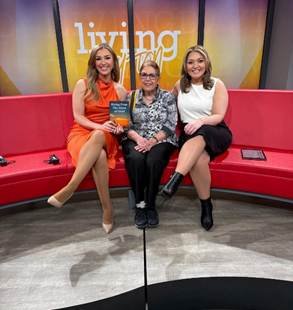
The response reflected what anyone who reads the book discovers quickly. She is not a new voice. She is a voice that has been saying important things for a long time, in classrooms and boardrooms and community halls, to audiences that were often smaller than her message deserved. The television appearance was not her arrival. It was a wider room finally opening up to someone who had earned the right to stand in it a long time ago.
The culture is catching up. It just took a while.
Rising From the Abyss of Grief is available now. It is the debut of a writer who did not need decades of publishing credits to know what she was doing. She just needed time to finish it.